“Hello and welcome. This is a shared space for our community and commercial partners to discuss Portland’s
geothermal potential—highlighting the facts we’ve already established and outlining the possibilities we still need to prove.”
— Darrell Morrison, Renewable Energy Advocate
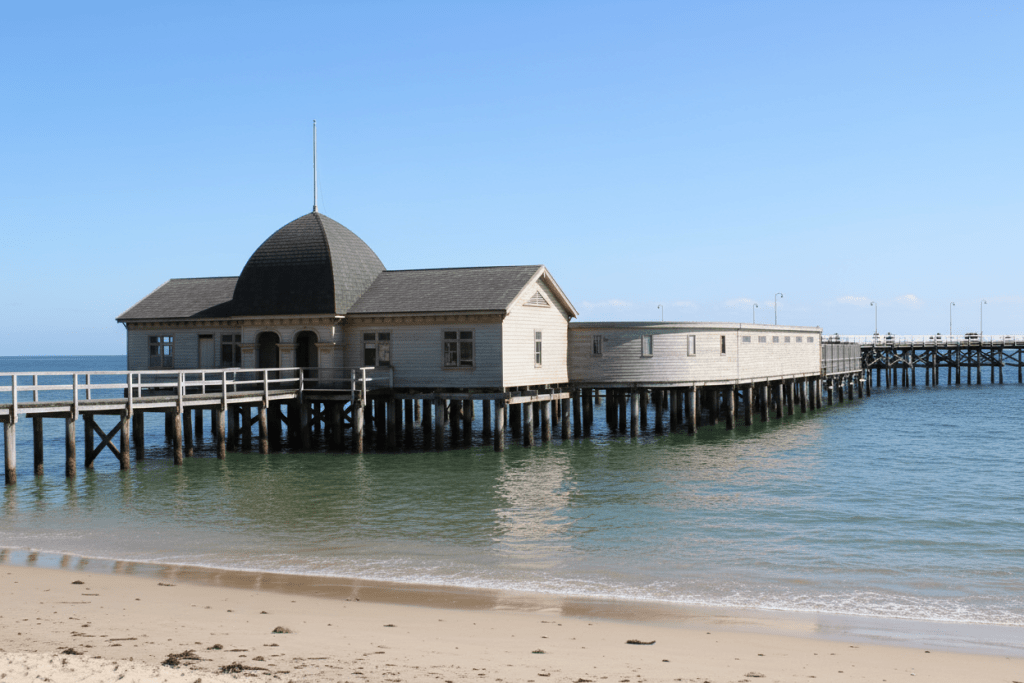
Graphic: a recreation of one of the three iterations of the Heated Bath houses that existed on Portland’s foreshore until the 1960s. Wood heating was used for the baths in the building, while protected ocean swimming was in a central enclosure.
This is a proposed research project to ascertain public and business interest in revisiting geothermal as a valuable local resource. This discussion is under the banner of what I call a , Modular Anchored Geothermal Microgrid (MAGM). This is an independent initiative seeking a modern scientific, engineering, environmental, and commercial feasibility study. The modular aspect allows many ideas to be tied together to share resources, boost heat, and distribute it (and maybe electricity) into the community and the state power grid. Details on this page may change, so save anything you want to keep, and keep visiting for updates.

By Darrell Morrison
Geothermal boosted if you will
As part of the initial idea to restart geothermal for heat in Portland, the question was raised. ‘Should we raise or boost the low-grade heat available using renewables?’ To that end, detailed investigations were made to see what resources were available to assist that process.
This line of thought runs parallel to the very basic premise of straight-up taking heat off the water extracted as was done successfully in Portland from 1983-2006.
Portland’s geothermal future and the smelter’s changing energy needs
In addition to wind or solar, there is potential for Waste Heat Recovery (WHR) systems which are designed to capture heat that would otherwise be wasted in industrial processes, such as exhaust gases, cooling water, or flue gases, and convert it into usable energy like electricity, steam, or mechanical power.
WHR is widely applied in power plants, manufacturing facilities, steel mills, cement plants, and large ships, making it a key strategy for energy efficiency and sustainable development.
Like all good ideas, and investigations, sometimes you reach an inconclusive outcome or even dead-end.
Alcoa is well-advanced with emissions reduction on a global scale
Even though, we came up empty-handed. We learned a lot more about the energy landscape here, and the national ramifications or technologies and legislation.
Portland has successfully used this geothermal heat before
Portland’s proposed geothermal research will need to proceed without a hoped-for supply of waste heat (WHR) from the aluminium smelter.
Over the past twelve-months, I have approached Alcoa about possible cooperation with the Portland Geothermal Energy Research Project. Its response has been courteous, referring to other initiatives it is pursuing, but no commitment to provide waste heat or participate in the research has been secured, now or later.
That changes one part of the proposal. It does not end the geothermal investigation. Industrial heat was an exciting possible addition to a geothermal-led system, not the resource on which the whole project depended. Indeed, the premise is ‘Modular’. As in Modular Anchored Geothermal Microgrid (MAGM).
Portland has successfully used this geothermal heat before
From 1983 to 2006, Portland operated a geothermal district-heating system using naturally warm groundwater from the Dilwyn Aquifer. Water drawn from about 1,400 metres underground, at approximately 58°C, supplied heat to public and commercial buildings. The arrangement recovered energy from water that originally also served the town’s drinking-water supply.
The present proposal asks whether that experience can inform a modern system. It is not a plan to reopen the old bore or reproduce the former network.
The Portland Geothermal Energy Research Project, using the working model name MAGM, remains at the scoping and stakeholder-engagement stage. MAGM means Modular Anchored Geothermal Microgrid. In practice, it describes separate energy components that could work together where the research supports doing so.
Potential uses include heating for civic buildings, the hospital, swimming facilities, accommodation, businesses and possibly homes. The study would need to establish actual demand, connection costs and customer interest before recommending any network.
Useful heat does not always need to be hotter
One possibility examined during the past year was combining geothermal heat with recovered industrial heat. Whether that improves the result depends on the temperatures available, the equipment required and the needs of the eventual users.
Cooler industrial air cannot simply raise the temperature of hotter geothermal water. A heat pump can use electricity to lift low-temperature heat to a useful temperature, but its electricity consumption must be included in the calculation. The International Energy Agency identifies this as an established way of using low-temperature waste heat in district-heating systems.
Nor does a modern shared heating network necessarily require hotter water throughout its pipes. Fifth-generation district heating and cooling (5GHC) generally uses a shared loop closer to ambient temperature, with heat pumps at individual buildings providing the heating or cooling required.
Other district-heating arrangements distribute warmer water directly. These are different options, not interchangeable descriptions of the same design.
For Portland, the research should compare those options rather than choose one in advance. Any proposed recovery from drinking-water infrastructure would also need to keep the water supply protected and separate from industrial or building-heating circuits.
The smelter’s electricity arrangements are changing
Portland Aluminium has its own substantial energy requirements and investment decisions. Its published agreements with AGL cover 300 megawatts and a further 287 megawatts of electricity supply, commencing in July 2026 and extending to June 2035. The additional agreement includes an option to replace part of the contracted supply with renewable electricity through AGL.
These agreements provide a more concrete account of the smelter’s direction than speculation about which technologies it might adopt.
Victoria’s legislated target is 95 per cent renewable electricity generation by 2035. A lower-emissions electricity supply can reduce the emissions associated with running an electricity-intensive facility, although the actual result depends on its supply arrangements, consumption and emissions accounting. A statewide target is not a guarantee that every industrial customer is already using entirely renewable power.
Portland also provides flexibility through its electricity contracts. AGL’s agreements allow short-term reductions in smelter consumption at times of peak demand. This is sometimes compared with a “virtual battery”, but the distinction is important: the smelter reduces its demand rather than storing electricity and later generating it.
New smelting technology is advancing
ELYSIS, the technology partnership involving Alcoa and Rio Tinto, is developing inert anodes to replace the carbon anodes used in conventional aluminium smelting. The process produces oxygen instead of the direct greenhouse gases associated with the conventional smelting reaction. In November 2025, ELYSIS announced the successful start-up of a commercial-size, 450-kiloampere cell at Rio Tinto’s Alma smelter in Canada.
𝘛𝘩𝘢𝘵 𝘪𝘴 𝘢 𝘴𝘪𝘨𝘯𝘪𝘧𝘪𝘤𝘢𝘯𝘵 𝘥𝘦𝘷𝘦𝘭𝘰𝘱𝘮𝘦𝘯𝘵, 𝘣𝘶𝘵 𝘪𝘵 𝘪𝘴 𝘯𝘰𝘵 𝘢𝘯 𝘢𝘯𝘯𝘰𝘶𝘯𝘤𝘦𝘥 𝘪𝘯𝘴𝘵𝘢𝘭𝘭𝘢𝘵𝘪𝘰𝘯 𝘢𝘵 𝘗𝘰𝘳𝘵𝘭𝘢𝘯𝘥.
Alcoa has described ELYSIS as technology intended for both new smelters and retrofits. The published announcements do not establish a Portland conversion date or a site-specific cost.
Any claims that it will certainly arrive here, or could never be installed here, go beyond that evidence. We do not know.
Cleaner smelting technology and cleaner electricity also address different sources of emissions. Changing the anodes does not remove the emissions associated with producing the electricity or alumina used by the smelter. Alcoa itself describes low-carbon aluminium as requiring attention to the process, power supply and raw materials.
Exemptions and environmental duties are different things
Victoria’s energy-upgrade arrangements include exemptions for specified large industrial premises. The Portland smelter’s address appears in the regulations’ list of scheduled activity premises (SAP). This classification concerns participation in the Victorian Energy Upgrades programme and associated scheme costs. It is not a general exemption from environmental responsibility.
Victoria’s general environmental duty requires businesses to minimise risks of harm from pollution and waste so far as reasonably practicable. The assessment includes the seriousness of the risk, available controls, their suitability and cost. It does not automatically require a business to adopt every proposed heat-recovery technology. This we understand and respect.
Separate Commonwealth obligations apply through the Safeguard Mechanism. Alcoa Portland Aluminium is listed among the scheme’s registered responsible emitters. Covered facilities must manage their net emissions against a baseline that generally tightens over time. The standard baseline decline rate is 4.9 per cent annually through June 2030, although eligible trade-exposed facilities can receive a lower rate.
This is not the same as requiring every facility to cut its physical emissions by exactly 4.9 per cent each year. The scheme allows eligible credits and other specified arrangements to manage excess emissions. Improvements elsewhere in a corporate group do not automatically discharge an individual facility’s obligations.
Alcoa’s published ambition of net zero across its global smelting and refining operations by 2050 is another consideration. A corporate ambition and a facility’s legal obligations are related, but they are not the same measure.
A separate role for community research
Alcoa’s commercial plans and Portland’s community research need not cover identical ground.
The purpose of PGERP is to establish whether geothermal heat can be used safely and economically for local benefit. That enquiry can continue without assuming access to Alcoa’s equipment, confidential information or waste heat.
Any future industrial contribution would need its own assessment of heat quality, capture costs, maintenance, ventilation, environmental effects and operating reliability. It would also require the owner’s agreement. An attractive diagram is not enough to establish a dependable heat supply.
𝘍𝘰𝘳 𝘯𝘰𝘸, 𝘵𝘩𝘦 𝘨𝘦𝘰𝘵𝘩𝘦𝘳𝘮𝘢𝘭 𝘲𝘶𝘦𝘴𝘵𝘪𝘰𝘯𝘴 𝘳𝘦𝘮𝘢𝘪𝘯. 𝘏𝘰𝘸 𝘮𝘶𝘤𝘩 𝘶𝘴𝘦𝘧𝘶𝘭 𝘩𝘦𝘢𝘵 𝘪𝘴 𝘢𝘷𝘢𝘪𝘭𝘢𝘣𝘭𝘦? 𝘊𝘢𝘯 𝘪𝘵 𝘣𝘦 𝘳𝘦𝘤𝘰𝘷𝘦𝘳𝘦𝘥 𝘧𝘳𝘰𝘮 𝘸𝘢𝘵𝘦𝘳 𝘢𝘭𝘳𝘦𝘢𝘥𝘺 𝘳𝘦𝘲𝘶𝘪𝘳𝘦𝘥 𝘧𝘰𝘳 𝘢𝘯 𝘢𝘱𝘱𝘳𝘰𝘷𝘦𝘥 𝘶𝘴𝘦? 𝘞𝘰𝘶𝘭𝘥 𝘢𝘯𝘰𝘵𝘩𝘦𝘳 𝘦𝘹𝘵𝘳𝘢𝘤𝘵𝘪𝘰𝘯 𝘰𝘳 𝘤𝘭𝘰𝘴𝘦𝘥-𝘭𝘰𝘰𝘱 𝘢𝘳𝘳𝘢𝘯𝘨𝘦𝘮𝘦𝘯𝘵 𝘣𝘦 𝘱𝘳𝘦𝘧𝘦𝘳𝘢𝘣𝘭𝘦? 𝘞𝘩𝘪𝘤𝘩 𝘤𝘶𝘴𝘵𝘰𝘮𝘦𝘳𝘴 𝘢𝘳𝘦 𝘤𝘭𝘰𝘴𝘦 𝘦𝘯𝘰𝘶𝘨𝘩 𝘵𝘰 𝘫𝘶𝘴𝘵𝘪𝘧𝘺 𝘵𝘩𝘦 𝘱𝘪𝘱𝘦𝘴, 𝘱𝘶𝘮𝘱𝘴 𝘢𝘯𝘥 𝘰𝘯𝘨𝘰𝘪𝘯𝘨 𝘮𝘢𝘪𝘯𝘵𝘦𝘯𝘢𝘯𝘤𝘦?
Water protection, cost and useful demand must determine the answers.
Establishing a credible independent research process
I have no commercial interest in the outcome. My role is to assemble the evidence, invite scrutiny and help establish a credible independent research process.
The proposed sequence is to refine the research questions with a small technical-civic panel, seek stakeholder comment, obtain quotations from qualified researchers and then raise the necessary funds. A commissioned study would have defined responsibilities, milestones and public reporting.
Government departments, universities, local organisations and prospective users can contribute without endorsing a particular design. Their involvement would help establish whether the questions are sound and whether the work serves a genuine public purpose.
𝙋𝙤𝙧𝙩𝙡𝙖𝙣𝙙’𝙨 𝙚𝙖𝙧𝙡𝙞𝙚𝙧 𝙜𝙚𝙤𝙩𝙝𝙚𝙧𝙢𝙖𝙡 𝙨𝙮𝙨𝙩𝙚𝙢 𝙥𝙧𝙤𝙫𝙞𝙙𝙚𝙨 𝙚𝙭𝙥𝙚𝙧𝙞𝙚𝙣𝙘𝙚 𝙩𝙤 𝙙𝙧𝙖𝙬 𝙤𝙣. 𝙈𝙤𝙙𝙚𝙧𝙣 𝙧𝙚𝙨𝙚𝙖𝙧𝙘𝙝 𝙢𝙪𝙨𝙩 𝙚𝙨𝙩𝙖𝙗𝙡𝙞𝙨𝙝 𝙬𝙝𝙖𝙩 𝙧𝙚𝙢𝙖𝙞𝙣𝙨 𝙥𝙧𝙖𝙘𝙩𝙞𝙘𝙖𝙡 𝙩𝙤𝙙𝙖𝙮, 𝙬𝙝𝙖𝙩 𝙞𝙩 𝙬𝙤𝙪𝙡𝙙 𝙘𝙤𝙨𝙩 𝙖𝙣𝙙 𝙬𝙝𝙞𝙘𝙝 𝙤𝙥𝙩𝙞𝙤𝙣𝙨 𝙨𝙝𝙤𝙪𝙡𝙙 𝙣𝙤𝙩 𝙥𝙧𝙤𝙘𝙚𝙚𝙙.
Read more about Alcoa’s innovations here:
https://elysis.com/en oh, and the exciting Alcoa patented technology called ASTRAEA™ https://www.alcoa.com/global/en/stories/releases
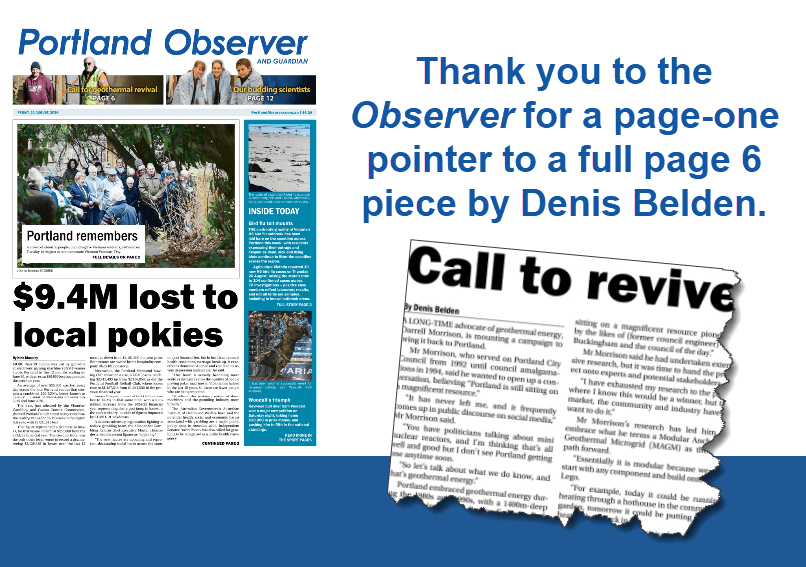
Portland operated a geothermal district heating system from 1983 to 2006.
Read all about it on page 3 of our HEAT download booklet below.
The MAGM project (Portland Geothermal) is seeking the financial and scientific evidence needed to determine what a modern system could contribute today.
Portland was using geothermal heat in 1983, decades before geothermal became part of Australia’s modern clean-energy debate.
For more than 20 years, naturally heated groundwater from beneath Portland supplied useful heat to public, community and commercial buildings.
MAGM is an independent Portland initiative seeking a modern scientific, engineering, environmental and commercial feasibility study.
The purpose is not to promote a predetermined project. It is to establish what Portland’s documented geothermal resource and wider geological potential could safely, sustainably and economically contribute today.
Portland has already demonstrated that geothermal heat can be used locally. The next step is to determine what modern science and engineering can achieve with that foundation.
Current status: August 2026
No construction project is being presented for approval.
No drilling programme, development site, generating technology or commercial model has been selected.
The immediate objective is to:
1. Define the feasibility-study scope.
2. Secure approximately $600,000 to $1.4 million for the necessary investigations.
3. Appoint an independent, multidisciplinary team of appropriately qualified experts.
The proposed funding is for evidence gathering, testing, design and commercial evaluation. Empirical studies and data enable strong funding applications for federal and private sector money that is available. It is not a construction budget.
Portland’s geothermal story at a glance
Proven local use
Portland operated a small geothermal district heating system from 1983 to 2006.
Documented underground heat
Warm groundwater at approximately 58-61 degrees Celsius was recovered from a bore about 1,400 metres deep.
A practical community system
The heat served the municipal swimming pool, hospital and a range of civic, community and commercial buildings.
The present objective
Secure approximately $600,000 to $1.4 million for an independent feasibility programme, not construction.
Who would conduct the research? A locally developed scope would be tendered out to suitably qualified universities and financial actuaries; and specialists in environmental policy.
Funding options:
Direct stakeholder partner sponsorship support in cash.
Approved environmental crowdfunding platforms.
Private donations.
Portland has already made geothermal work
Portland is not beginning with an untested idea.
Warm groundwater from the Henty Park bore was used to heat the municipal swimming pool and a network of public, community and commercial buildings. The system operated as practical civic infrastructure for more than two decades.
That history gives Portland something unusual in Australian geothermal development: evidence of sustained, real-world use.
The former system demonstrated that useful geothermal heat could be recovered and distributed locally. It also generated valuable experience involving bore performance, water temperature, flow, heat exchange, reticulation, building demand, maintenance and system operation.
This history is documented in the supporting papers available below.
What the previous system proves
Portland’s earlier system proves that useful direct geothermal heat was available and could be put to work.
It provides a strong foundation for renewed investigation.
It does not automatically prove that rebuilding the former system would be the best option today. It does not establish the current cost of a new system, nor does it prove that Portland has a deeper resource suitable for electricity generation.
Those are separate questions requiring contemporary evidence.
The previous system is a reason to investigate. It is not a reason to skip the investigation.
Why test the resource again?
Technology, environmental requirements, energy markets and community expectations have changed considerably since Portland’s original system was designed.
The former installation relied on the extraction of warm groundwater and the surface disposal of the cooled water. Reinjection was not part of the original infrastructure.
When the surrounding water-supply and disposal arrangements changed, the system no longer had a durable operating pathway.
The underground heat had not simply disappeared. The difficulty was that the original system had not been designed around the water-management, environmental and operating conditions that later applied.
Any new investigation must learn from that experience.
A twenty-first-century geothermal system would need to consider the complete resource and water cycle from the beginning. Depending on the scientific findings, this could involve reinjection, closed-loop technology, improved reservoir management, new monitoring systems, different well configurations or another environmentally acceptable approach.
Portland should not attempt to reproduce the 1983 system exactly as it was.
The purpose is to understand what worked, identify why it eventually ceased operating, and investigate what a durable modern system would require.
What Portland has today
Portland already has a substantial starting point.
This includes historical bore records, temperature and flow information, records from the former district heating system, regional geological studies, Otway Basin exploration data and decades of practical local experience.
Portland also has an unusual concentration of potential energy users and supporting infrastructure, including major industry, public institutions, agriculture, forestry, a deep-water port, transmission assets, renewable generation and emerging fuel and energy developments.
These elements do not establish a business case by themselves.
They do, however, justify bringing the evidence together and asking whether a modern geothermal opportunity exists.
The distinction must remain clear:
Portland has a proven history of direct geothermal use and credible reasons for further investigation. It does not yet have a contemporary, independently verified resource model, engineering design or commercial business case.
What is MAGM?
MAGM stands for Modular Anchored Geothermal Microgrid.
Modular means small energy inputs like solar can be linked; the project, if successful, can be created in affordable stages and grow naturally with opportunities and our energy needs. The name describes an approach to investigation. It does not describe a completed project. This particular focus is all about centralising geothermal in the model being proposed for research and funding opportunities.
Anchored
Geothermal is the primary resource being examined.
The study must begin with Portland’s geology, hydrogeology, temperatures, flow, pressure, water chemistry and sustainable resource capacity.
Other technologies cannot compensate for an unsuitable geothermal resource. The geothermal evidence must stand on its own.
Modular
Possible applications can be evaluated and developed in stages.
Portland would not need to begin with one large, all-or-nothing project. A smaller direct-heat application, test site or demonstration may prove to be the most responsible starting point.
Additional users or technologies would be considered only where operating results and further analysis justified expansion.
Microgrid
A microgrid could coordinate local heat, electricity, storage, controls and participating energy users where that arrangement produces a measurable benefit.
It would not necessarily disconnect participating users from the wider electricity grid.
A microgrid is a possible supporting structure, not the reason for investigating geothermal.
Three foundations for a credible feasibility study
1. A properly designed scope
Before a panel of researchers can begin, the questions they are expected to answer must be clearly defined.
The scope would distinguish between Portland’s demonstrated shallow, direct-use geothermal opportunity and any deeper, higher-temperature potential that might support industrial heat or electricity generation.
It would identify the geographic area, resource targets, available evidence, information gaps, water-protection requirements, likely users, environmental questions, engineering options, commercial tests and decision points.
The scope must be broad enough to identify beneficial opportunities, including those not yet apparent.
It must also be disciplined enough to prevent the study from becoming an unfocused examination of every available energy technology.
Most importantly, the appointed experts must be free to modify, narrow or reject parts of the MAGM model where the evidence requires it.
2. Sufficient funding
The present working estimate for the feasibility programme is approximately $600,000 to $1.4 million.
The final amount will depend on the scope developed with researchers, technical advisers and prospective funding partners.
The lower end may support a substantial desktop, modelling, engineering and commercial programme using existing information.
The upper end may be required if the experts determine that field investigations are necessary. These could include geophysical surveys, new downhole measurements, flow testing, water sampling, reinjection testing, small-diameter pilot holes, test bores or trials of relevant surface technologies.
Any fieldwork would require the appropriate design, approvals, environmental safeguards and professional supervision.
The purpose of the expenditure is straightforward:
Replace assumptions with measurements.
3. An independent expert team
A credible feasibility study cannot be completed by one advocate, consultant, company or technical discipline.
It would require a multidisciplinary research and investigations team selected for the questions defined in the scope.
Expertise may be required in:
Geothermal geology and geophysics.
Hydrogeology and groundwater management.
Reservoir engineering.
Drilling and well design.
Water chemistry, corrosion and mineral scaling.
Environmental science and monitoring.
Direct-use geothermal systems.
Industrial process heat and heat pumps.
District energy and thermal storage.
Electricity systems, storage and microgrids.
Virtual power plants and demand management.
Energy economics, finance and investment.
Planning, regulation and approvals.
Governance, ownership and community engagement.
Traditional Owner knowledge and participation must also be incorporated from the beginning, not added after the technical work has been completed.
The findings should be independently reviewed and presented in a form that government, industry, researchers, investors and the community can scrutinise.
What the study may need to investigate
Historical evidence
The first task would be to recover and audit the available bore logs, temperature measurements, flow and pressure data, water chemistry, geological records, network plans, operating records and decommissioning information.
This would establish which historical information remains reliable and where new measurements are required.
The geothermal resource
Specialists would develop a modern model of the shallow and deeper formations beneath Portland and the surrounding district.
This would examine depth, temperature, thickness, permeability, pressure, likely flow, geological structure, water chemistry and sustainable reservoir behaviour.
It would also identify the most important uncertainties and determine whether further surveys, measurements or test drilling are justified.
Water and environmental protection
The Dilwyn Aquifer is both a possible heat resource and an important regional water source.
Any proposal involving it must demonstrate protection of water quality, pressure, sustainable yield and security of supply.
The study would examine reinjection, closed-loop alternatives, potential contamination pathways, aquifer interaction, induced seismicity, surface impacts, land requirements and long-term monitoring.
Groundwater protection must be an early design condition. It cannot be treated as an issue to resolve after a preferred project has already been chosen.
Real energy demand
Heat has value only where a suitable user can make practical use of it.
The study would map the amount, temperature, timing and location of heat required by public facilities, businesses, industry, agriculture and possible new developments.
Those requirements would then be compared with the temperature and output the resource could realistically supply.
This may reveal a compact precinct opportunity, several smaller users, a staged network or applications that are too distant or technically unsuitable.
Engineering options
The study should compare production and reinjection wells, closed-loop systems, heat exchangers, heat pumps, direct heating networks, thermal storage, monitoring and control systems.
Where the deeper resource justifies investigation, it should also examine electricity generation technologies suited to the temperatures available.
Each option must be assessed for reliability, maintenance, redundancy, construction risk, operating life, environmental performance and compatibility with existing infrastructure.
Economics and commercial viability
Independent modelling would examine drilling and construction costs, operating expenses, maintenance, resource risk, delivered cost of heat, possible electricity value, replacement costs, approvals, insurance and long-term liabilities.
Geothermal must be compared with realistic alternative energy options using consistent assumptions.
A concept may be technically possible but financially unsuitable.
Conversely, a modest direct-heat application may prove more valuable and achievable than a larger electricity-generation proposal.
Why pilot holes or technology trials may be necessary
Historical records provide a valuable foundation, but they cannot answer every contemporary engineering and commercial question.
Existing information may not be sufficient to confirm current temperatures, pressure, permeability, sustainable flow, water chemistry or reinjection performance at the locations being considered.
The appointed experts may therefore recommend small-diameter pilot holes, test bores, flow tests, downhole logging or other investigations.
These would not constitute approval of a commercial project.
They would be data-collection tools, used only where the expected information justified the cost and disturbance.
Surface technology trials may also be useful. These could test heat exchangers, industrial heat pumps, thermal storage, digital controls, water treatment or other systems without committing Portland to full-scale development.
Future-proofing any new wells and infrastructure
Any new well or surface system must be designed for more than its first intended use.
Future-proofing may include:
Provision for reinjection or closed-loop operation.
Long-term reservoir and groundwater monitoring.
Access for future logging, testing and maintenance.
Management of corrosion, mineral scaling and water chemistry.
Appropriate spacing between production and reinjection wells.
Compatibility with heat pumps, heat exchangers and thermal storage.
The ability to serve more than one suitable user.
Staged expansion where the evidence supports it.
Redundancy if a well or surface plant becomes unavailable.
Adaptability if environmental standards, energy markets or local demand change.
The objective is to avoid creating infrastructure that later becomes stranded because an essential water-management, environmental or operating requirement was not considered at the beginning.
Geothermal first, complementary systems second
MAGM is anchored in geothermal energy.
The first question is whether Portland has a resource that can be developed safely, sustainably and economically.
Only after that question is answered should the study determine which applications and complementary systems are justified.
These may include direct heating, industrial process heat, heat pumps, district heating, thermal storage, electricity generation, batteries, demand management, waste-heat recovery, bioenergy, renewable fuels or hydrogen.
Some may improve the geothermal opportunity.
Others may add expense and complexity without sufficient benefit.
Each technology must earn its place through evidence.
Finding beneficial linkages
A multidisciplinary study may identify opportunities that are not visible when geothermal, electricity, water, industry and regional development are considered separately.
Cascading heat
Higher-temperature heat could potentially serve one user first, with the remaining lower-temperature heat then supplied to another application.
This could increase the useful energy recovered from each unit of geothermal heat.
Shared infrastructure
Several users may be able to share wells, heat exchangers, pipelines, storage, monitoring, maintenance and other infrastructure.
Shared use can improve utilisation and reduce the cost carried by any one participant.
Industrial symbiosis
The heat, water, energy, infrastructure or by-products of one operation may become useful inputs for another.
This could create linkages with food production, greenhouses, aquaculture, forestry, minerals processing, waste management or emerging fuel industries.
Thermal and electrical storage
Thermal storage may allow geothermal heat to be collected steadily and delivered when demand is highest.
Electrical storage may support pumps, controls, local reliability and complementary renewable generation.
Virtual power plants
A virtual power plant, or VPP, coordinates distributed generation, storage and controllable energy loads.
A VPP (software managed by experts) would not create Portland’s geothermal resource. It may, however, help coordinate supporting electrical assets, flexible demand and local energy services.
New fuels and emerging industries
The study should remain alert to developments involving renewable fuels, bioenergy, hydrogen, low-carbon liquid fuels and other emerging regional industries.
Geothermal heat or shared infrastructure may prove useful to some of these activities.
No connection should be assumed or promised in advance. The purpose is to identify where genuine technical and commercial synergies exist.
Scaling opportunity while reducing risk
The modular approach allows Portland to proceed in stages.
A first stage could focus on the lowest-risk application supported by the evidence. That stage would generate current operating data about temperature, flow, water chemistry, equipment performance, demand and cost.
Later stages would proceed only if the results justified them.
Scaling may improve viability where it allows several users to share infrastructure, matches different heat grades to different applications, increases equipment utilisation or creates more than one source of value.
It can also increase complexity.
The feasibility study must determine where scale reduces risk and where it creates additional exposure.
The objective is not to make the concept as large as possible.
It is to find the scale that produces the best technical, environmental, economic and community outcome.
What the feasibility funding must produce
The intended result is not simply another discussion paper.
The feasibility programme should produce an evidence package suitable for consideration by government, industry, research institutions, infrastructure providers and investors.
That package should include:
A contemporary, independently reviewed geothermal resource model.
A clear account of what is known, what remains uncertain and what further testing is required.
Preliminary engineering designs for the most credible applications.
Water-management and environmental protection options.
Indicative capital and operating costs.
Estimates of useful heat, electricity or other energy that may be supplied.
Comparison with realistic alternative energy options.
A planning, regulatory and approvals pathway.
A staged development plan with clear stop, reconsider or proceed points.
A commercial business case suitable for approaching investors, industry and substantial government funding programmes.
Without this information, decision-makers cannot responsibly assess major project funding.
With it, Portland would have a defensible basis for proceeding, changing direction or concluding that development is not justified.
What we are asking of the community
The community is not being asked to approve construction.
It is not being asked to accept that every part of MAGM will work.
It is being asked to support a fair, independent and properly resourced examination of Portland’s geothermal opportunity.
Residents, Traditional Owners, businesses, community organisations, researchers, utilities, public institutions and regional industries can help by discussing the proposal with their neighbours, professional networks and elected representatives.
The question for decision-makers is straightforward:
Will you support the funding needed for independent experts to determine what Portland’s geothermal resource can safely and economically contribute?
Building informed community and stakeholder support is necessary if the estimated $600,000 to $1.4 million feasibility programme is to be funded.
The eventual funding package may combine government programme, research institutions, industry, philanthropic support, investment and community participation.
Individual residents are not expected to finance the entire study.
The community’s immediate contribution is its attention, scrutiny and voice.
Share this page.
Discuss the opportunity with your neighbours and professional networks.
Raise it with local, Victorian and Australian decision-makers.
Ask that Portland’s geothermal opportunity be examined through evidence rather than assumption.
No predetermined conclusion
The feasibility study may find that direct heat is practical but electricity generation is not.
It may support a small precinct system rather than a city-wide network.
It may identify a deeper resource that warrants further exploration.
It may recommend a staged demonstration.
It may conclude that some applications are technically possible but commercially unsuitable.
It may find that part or all of the concept should not proceed.
Each of those findings would be useful.
The purpose is not to defend a preferred answer. It is to give Portland a reliable one.
We are not asking anyone to rule geothermal in. We are asking that Portland does not rule it out before the scientists, engineers and economists have been able to do their work.
Who is behind MAGM?
Hi, and thank you for reading this far. I am Darrell Morrison, a Portland resident with a professional background in media, communications, marketing and design, together with previous service in local government.
My interest in Portland’s geothermal story began in the 1980s, when I assisted the Portland Development Committee with material concerning geothermal and alternative energy.
I later served on the former City of Portland Council and have continued to follow regional energy, infrastructure and economic-development issues.
I am not presenting myself as the geologist, reservoir engineer or project developer who should decide the technical case.
My role is to bring Portland’s historical record and its possible modern opportunity into one discussion, assemble the available evidence, seek support for an independent investigation and ensure the question is tested rather than forgotten.
The decision we are seeking now
The present request is limited and practical.
As an intersted party, I need your help. We need to psuh the conversation forward, and fund the study to answer the biggest question.
First, define a rigorous scope.
Second, secure the funds.
Third, appoint the appropriate independent experts.
Fourth, collect the necessary evidence.
Fifth, prepare the business case.
Only then should decisions be made about investment, demonstration or development.
The next decision is not whether Portland should build a geothermal project.
The next decision is whether Portland’s documented geothermal history and geological potential deserve a properly funded modern feasibility study.
My own citizen scientist investigations raised lots of exciting questions and a few intriguing alternatives, so that’s why we need to talk, and we need to act.
Please engage. Ask questions. Talk about our geothermal advantages, and do become part of something special. Email me, Darrell Morrison, c/- magm@bizgen.com.au
Please note before: as a concept, some, none, or all aspects in this schematic shown may be eventually included.
A detailed study and stakeholder interest will determine future outcomes.
Many stakeholders have been contacted over the past 12-months. If I missed you, please accept my apology.
Bizgen® Australia
Portland Victoria